MIND — Cognitive Health Monitoring
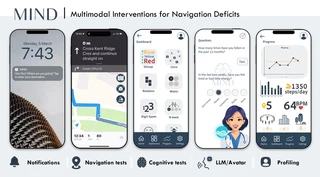
Overview
The MIND (Monitoring and Supporting Cognitive Health) project creates a mobile platform for the early detection of cognitive impairment in aging populations. Early identification of decline — before it significantly impacts daily life — enables timely intervention, supports independent living, and improves long-term outcomes for older adults and their families.
MIND is part of the Future Health Technologies 2 (FHT2) initiative, a major research program funded by the National Research Foundation Singapore (NRF) CREATE grant.
Motivation
Cognitive decline — from mild cognitive impairment to dementia — affects hundreds of millions of people worldwide. Current clinical detection relies predominantly on periodic in-clinic assessments that are episodic, costly, and often catch decline only after substantial impairment has occurred. A continuously operating, passive monitoring system that can detect subtle early warning signs in everyday behavior could transform the standard of care.
Two key insights motivate the MIND approach:
- Movement and navigation encode cognition: Changes in how people navigate their environment — route choices, wayfinding strategies, spatial memory — are among the earliest and most sensitive indicators of cognitive decline. Analyzing GPS and sensor traces at scale can reveal these changes.
- Language reflects cognitive health: Subtle changes in vocabulary, sentence complexity, topic management, and response latency in everyday conversation are measurable markers of cognitive change, detectable through automated language analysis.
Approach
MIND integrates three complementary AI systems into a unified mobile platform:
Large Geospatial Models (LGMs)
Large Geospatial Models analyze longitudinal GPS and mobility traces to detect patterns indicative of cognitive change. These include:
- Route repetitiveness: Increasing restriction of daily movement range
- Navigation errors: Unusual detours or disorientation in familiar environments
- Mobility diversity: Changes in the variety of visited locations over time
LGMs are trained on large-scale mobility datasets and fine-tuned to identify individual-level deviations from baseline behavior.
LLMs for Conversational Cognitive Assessment
Large language models analyze conversation transcripts from daily interactions with the MIND app, detecting cognitive markers such as:
- Reduced lexical diversity and increased use of filler words
- Difficulty with topic maintenance and coherence
- Slowed response generation and increased hesitation
- Confusion or confabulation in response to everyday questions
These markers are tracked longitudinally to identify meaningful change relative to the individual’s own baseline.
Embodied Avatars for Guided Assessment and Training
An embodied conversational avatar conducts structured cognitive assessments — such as memory recall tasks, verbal fluency tests, and orientation questions — through natural spoken dialogue. The avatar also guides cognitive training exercises designed to maintain cognitive reserve.
The embodied format is critical: older adults are more likely to engage regularly with an interactive, socially present agent than with a text-based questionnaire or passive sensor. The avatar adapts its communication style to individual users, adjusting vocabulary, pacing, and support level to ensure accessibility.
Integration and Privacy
All three systems operate on a shared mobile platform with strong privacy protections. Data is analyzed on-device where possible, and users maintain full control over what is shared with care providers. The platform produces structured reports for geriatricians and primary care physicians, enabling early clinical intervention.
Significance
MIND represents a convergence of several research threads — geospatial AI, conversational AI, affective computing, and embodied interaction — applied to one of the most pressing health challenges of our time. By enabling early, passive, continuous monitoring, the platform aims to support successful aging in place and to delay or prevent the transition to care dependency.
Research Partners and Funding
- National Research Foundation Singapore (NRF) CREATE — Future Health Technologies 2 (FHT2)
- Bond University (Australia)
- Collaboration with life sciences and medicine partners in Singapore

I am a Senior Researcher & Lecturer at the Computer Graphics Laboratory of ETH Zurich, and a Research Consultant at Disney Research. I lead the Digital Character AI team at CGL and, as PI of an SNF Ambizione grant, a line of generative models that produce expressive 3D facial animation from speech and text under explicit control of emotion and expression. My research interests include conversational digital characters, generative animation, affective computing, human-computer interaction, and applied machine learning.
My vision is to create intelligent digital humans that can naturally communicate, understand, and support people across domains such as education and mental health. My research focuses on multimodal artificial intelligence for interactive digital humans, developing models that combine large language models, affective computing, and data-driven animation to create embodied conversational agents endowed with autonomous agency, consistent values, and beliefs.
My work bridges machine learning, human–computer interaction, and computer graphics to enable AI systems such as Digital Einstein and interactive patient avatars for psychotherapy training and health education.