Toward Accessible Psychotherapy Training Using AI-Driven Interactive Patient Avatars

Jun 1, 2026·
P. Riachi
,
S. Kamber
,
S. Brogna
,
A. Gloster
Dr. Rafael Wampfler
Rafael Wampfler
Abstract
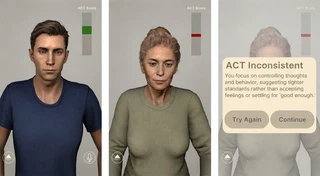
Training psychotherapists in evidence-based interventions such as Acceptance and Commitment Therapy (ACT) requires repeated practice with meaningful feedback, yet opportunities for safe, standardized training are limited by ethical, logistical, and resource constraints. We introduce a system designed to support ACT-oriented psychotherapy training through spoken dialogue with an embodied virtual patient. The system uses large language models to simulate patient behavior conditioned on profiles derived from real therapy sessions and configurable clinical scenarios, while a separate automated evaluator provides turn-by-turn feedback on therapist responses based on established ACT fidelity criteria. Rather than aiming to replace supervision, the system is intended to support deliberate practice by enabling experimentation, reflection, and immediate feedback in low-risk settings. Expert evaluation with practicing psychologists confirmed high realism in patient behavior and demonstrated that immediate turn-by-turn ACT feedback increased therapists’ awareness of intervention choices and enabled effective experimentation with alternative responses. Quantitative evaluation across 49 therapy transcripts identified GPT-4o-mini as the optimal feedback model, achieving the lowest mean absolute error (MAE = 6.12) in replicating human supervisor ACT fidelity ratings with statistically significant agreement. This work demonstrates the potential of fidelity-aware simulated patients as a scalable complement to psychotherapy training.
Type
Publication
In Proceedings of the 2026 IEEE International Conference on Healthcare Informatics (ICHI ‘26), Minneapolis, USA, pp. 994–999
publications

Honorable Mention Paper Award — IEEE International Conference on Healthcare Informatics (ICHI 2026), Minneapolis

Dr. Rafael Wampfler
Authors
Senior Researcher & Lecturer

I am a Senior Researcher & Lecturer at the Computer Graphics Laboratory of ETH Zurich, and a Research Consultant at Disney Research. I lead the Digital Character AI team at CGL and, as PI of an SNF Ambizione grant, a line of generative models that produce expressive 3D facial animation from speech and text under explicit control of emotion and expression. My research interests include conversational digital characters, generative animation, affective computing, human-computer interaction, and applied machine learning.

My vision is to create intelligent digital humans that can naturally communicate, understand, and support people across domains such as education and mental health. My research focuses on multimodal artificial intelligence for interactive digital humans, developing models that combine large language models, affective computing, and data-driven animation to create embodied conversational agents endowed with autonomous agency, consistent values, and beliefs.

My work bridges machine learning, human–computer interaction, and computer graphics to enable AI systems such as Digital Einstein and interactive patient avatars for psychotherapy training and health education.